
How a single cell-free protein synthesis platform serves the entire development journey — from microliter protein engineering to liter-scale biopharmaceutical production
June 2026

Overview
ALiCE® is the only eukaryotic CFPS platform that covers the complete biopharmaceutical development arc: 50 µL 96-well screening, 100 mL preparative reactions, and 1,000 mL bioreactor production — with the same protocol, the same lysate, the same reaction chemistry at every scale. The batch mode format (24-48 hours, 20-25°C) is compatible with standard bioreactor configurations without the membrane fouling, feeder systems, and process complexity of continuous-exchange approaches. Published process economics (Stamatis and Farid, 2021) identify titer as the dominant cost lever for CFPS manufacturing; ALiCE®’s 3 mg/mL yield achievements and eukaryotic PTM capability position it competitively for biopharmaceuticals where eukaryotic glycosylation is essential.
The Development Bottleneck in Biopharmaceutical Production
The development trajectory for a biopharmaceutical protein is long by necessity. Lead identification generates a protein sequence. Engineering optimises it for stability, affinity, and developability. Preclinical studies require milligrams. Phase I clinical trials require grams. Approval-scale manufacturing requires kilograms, continuously and reproducibly. Transitions between these stages typically require a combination of expression or equipment platform-switching, process re-optimization, and regulatory redocumentation.
The dominant paradigm — CHO cell culture for manufacturing, transient mammalian cell expression for early-stage research — works but is slow. Stable cell line development for a manufacturing candidate takes 38 months. The total development timeline from IND-enabling studies to first-in-human is typically 12–18 months, of which protein production and process development consumes a disproportionate fraction.
Cell-free protein synthesis offers an alternative architecture: a single platform that scales from research to manufacturing, with no cell line development and no process re-development at transitions. ALiCE® is the first eukaryotic CFPS system to simultaneously deliver eukaryotic PTM capability, adequate yield, and demonstrate linear scalability .
Stage 1 — Protein Engineering at Microliter Scale
ALiCE® reactions can be performed in 50–100 µL volumes in standard microtiter plates, directly compatible with liquid-handling automation and plate-reader detection. For antibody engineering campaigns, this enables parallel expression of variant libraries in 96-well format — different VH sequences, CDR mutations, Fc variants, or chain assembly ratios — with functional characterisation performed on clarified lysate without purification.
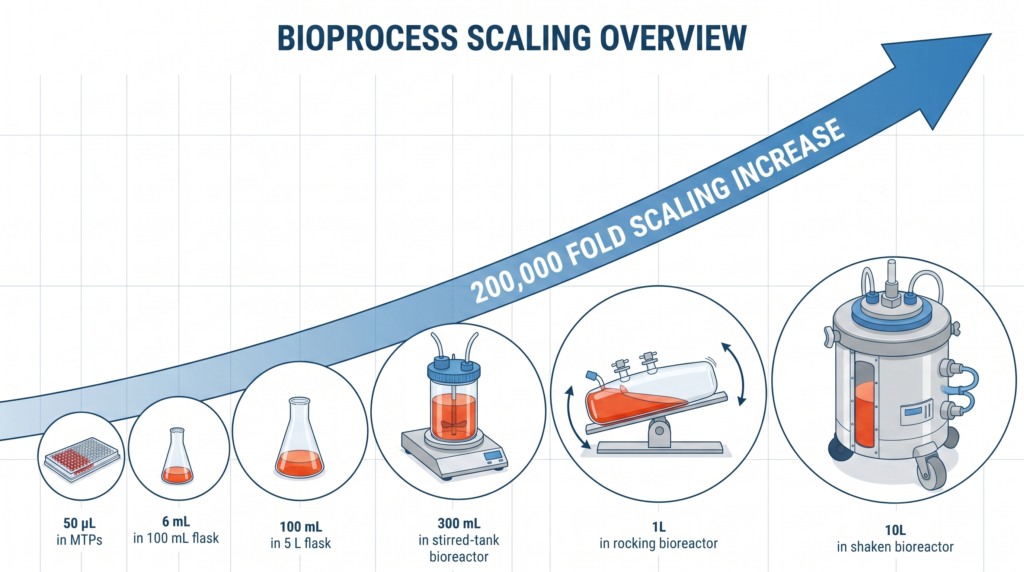
Because the system is linearly scalable, yield and quality at 50 µL predict yield and quality at 100 mL or 1,000 mL. There is no scale-up surprise. A lead candidate identified as the highest-yielding, most thermostable, or most functionally active variant at microscale will behave comparably at manufacturing scale.
Stage 2 — Preclinical Supply at Milliliter to 100 mL Scale
Moving from lead identification to preclinical characterisation requires milligrams of purified protein — enough for biophysical characterisation (DSF, SEC-MALS, DLS), structural biology (cryo-EM grid preparation, crystallisation trials), and in vitro pharmacology (binding assays, cell-based activity assays, toxicology studies). ALiCE® at 10–100 mL scale delivers this material within one week of plasmid availability, using standard Erlenmeyer flask culture and orbital shaking.
Das Gupta et al. (2022) performed detailed molecular characterisation studies — disulfide bond analysis by LC-MS/MS, N-glycan profiling by LC-ESI-MS/MS, and SPR binding kinetics — using protein produced at 10 mL scale. For a CHO-based process, obtaining equivalent material would require months of cell line development and upstream process characterisation.
Stage 3 — Manufacturing-Scale Production
The scalability of the ALiCE® platform was demonstrated by Das Gupta et al. (2023) through BY-2 lysate production and CFPS reactions spanning reaction volumes from 0.1 to 100 mL. Using the same lysate batches across all scales, cytosolic and microsomal ALiCE® reactions expressing eYFP and GOx showed strikingly linear scalability over a 1000-fold increase in reaction volume, with no significant loss in protein yield at the reaction endpoint. The authors further extended this work to a 1,000 mL CELL-tainer® CT20 CFPS reaction for cytosolic eYFP production, where comparison with 50 µL microtiter plate reactions showed no significant difference in protein yield across an overall scaling factor of 20,000x. Together, these findings demonstrate that the same underlying ALiCE® reaction chemistry and workflow can be maintained from microliter to liter scale, supporting that ALiCE® scale-up is primarily a bioprocess engineering exercise in which parameters such as oxygen transfer, mixing, and vessel geometry are aligned with the requirements of the reaction to enable consistent performance across scales. Subsequent internal development initiatives further demonstrated that optimized large-scale process conditions can achieve the expected high-productivity performance of the ALiCE® platform, including yields of approximately 3 g/L.
The process economics analysis by Stamatis and Farid (2021) at UCL provides the most rigorous published assessment of CFPS manufacturing economics. Modelling an ADC manufacturing process at 100 kg/year, they found that the CFS system shows approximately 65–85% higher cost of goods (COG/g) compared to CHO under current conditions — with the largest cost driver being the cell extract manufacturing process. Critically, sensitivity analysis identified titer as the single parameter with the greatest leverage on COG/g: doubling the CFS titer from 1 to 2 g/L reduces COG/g by ~21% at annual demand of 100 kg ALiCE®’s 3 mg/mL yield is directly relevant — higher titer translates directly to lower cost of goods.
- ALiCE® in Context — Platform Comparison
| Platform | System Type | Yield (Batch) | PTMs | Glycosylation | Membrane Proteins | Scalability | Primary Use Case |
| Sutro XpressCF® | E. coli extract (cell-free) | 0.3-1g/L | Limited | ❌ None | ❌ No | ✅ GMP, manufacturing scale | Clinical-stage ADCs |
| Wheat Germ Extract | Eukaryotic extract | 0.1–0.5 g/L | Limited | ⚠️ Minimal / inconsistent | ⚠️ Limited | ❌ mL-scale | Research, HTP screening |
| PURExpress® | Reconstituted E. coli | <1 g/L | ⚠️ Limited (e.g., disulfide bond formation with enhancer systems) | ❌ None | ❌ No | ❌ Not scalable | Mechanistic studies, synthetic biology |
| PUREfrex® | Reconstituted in vitro coupled transcription/translation system | ~0.1–0.6 g/L | ⚠️ Engineered PTMs (disulfide bonds, chaperone-assisted folding) | ⚠️ Add-on glycosylation demonstrated | ⚠️ Supported using detergents, nanodiscs, or liposomes rather than endogenous membranes | ⚠️ Preparative scale demonstrated | Synthetic biology, biologics R&D |
| ALiCE® | Eukaryotic (plant-based CFPS) | ~0.1-3.5 g/L | ✅ Yes | ✅ N-glycosylation* | ✅ Yes | ✅ Multi-order scale-up | Complex proteins, translational workflows |
* ALiCE® microsomal reactions support co-translational translocation and N-glycosylation-associated processing in endogenous plant microsomes.
ALiCE® uniquely combines three attributes rarely achieved together in CFPS: eukaryotic protein functionality, high yields, and scalable production potential.
This positions it at the intersection of discovery flexibility and manufacturing relevance, unlike existing platforms that optimize for only one dimension.
Key Data Summary:
- 50 µL to 1,000 mL: same protocol, same chemistry, linear yield
- 24- to 48-hour batch mode at 20- 25°C: no continuous-exchange, no fed-batch
- Commercial yield specification: ≥2 mg/mL eYFP
- Titer: 21% COG/g reduction per doubling of CFS titer (Stamatis and Farid, 2021)
- Time from plasmid to characterised protein: under one week
- Time for CHO stable cell line: 4–8 months
Frequently Asked Questions
Q: What does it cost to use ALiCE® for protein production?
A: Commercial pricing is available directly from LenioBio. Process economics modelling by Stamatis and Farid (2021) for E. coli-based CFPS systems shows ~65–85% higher COG/g than CHO at current titers — with titer as the dominant cost lever. ALiCE®’s 3 mg/mL yield is the highest published for eukaryotic CFPS and positions the platform well as scale-up and process optimisation continue.
Q: Is ALiCE® compatible with GMP manufacturing?
A: ALiCE® is currently a research-grade commercial product. The path to GMP compliance requires cGMP-banked BY-2 cell lines, sterile filtration of the extract, extended lot-release testing, and regulatory engagement on the classification of cell-free expressed biologics. The analytical framework demonstrated in Das Gupta et al. (2022) provides a foundation for a GMP quality system. Contact LenioBio directly for current GMP readiness status.
Q: How long does it take to produce research-grade protein in ALiCE®?
A: From plasmid to purified protein: gene cloning into pALiCE02 (1–2 days), 24 to 48-hour CFPS reaction, microsome harvest and purification (1-2 days). Total: under one week. This compares to 4–8 weeks for stable mammalian cell line development.
Q: Can ALiCE® produce difficult-to-express proteins that fail in cell-based systems?
A: Yes. As an open system without cell walls or membranes constraining the reaction, ALiCE® tolerates cytotoxic proteins that cannot be overexpressed in cell-based systems. Membrane proteins that are toxic to host membranes, transcription factors with non-specific DNA binding activity, and proteins that trigger cell death via apoptotic pathways can all be expressed in CFPS.
Q: What is the maximum protein yield achievable in ALiCE®?
A: The commercial specification is≥2 g/L for the eYFP reporter protein in sub-millilitre batch reactions — the highest published yield for a eukaryotic CFPS system in batch mode, approximately 15× higher than other commercial eukaryotic CFPS systems. Yields for individual target proteins will vary based on sequence, folding requirements, and expression mode.
References
[1] Das Gupta M et al. ALiCE®: A versatile, high yielding and scalable eukaryotic CFPS system. bioRxiv. 2022. https://doi.org/10.1101/2022.11.10.515920
[2] Stamatis C, Farid SS. Process economics evaluation of cell-free synthesis for ADCs. Biotechnol J. 2021;16:e2000238. https://doi.org/10.1002/biot.202000238
[3] Zawada JF et al. Microscale to Manufacturing Scale-up of Cell-Free Cytokine Production. Biotechnol Bioeng. 2011;108(7):1570–1578. https://doi.org/10.1002/bit.23103
[4] Yin G et al. Aglycosylated antibodies and antibody fragments produced in a scalable in vitro transcription–translation system. MAbs. 2012. https://doi.org/10.4161/mabs.4.2.19202
[5] Zawada JF et al. Microscale to manufacturing scale-up of cell-free cytokine production—A new approach for shortening protein production development timelines. Biotechnol Bioeng. 2011. https://pmc.ncbi.nlm.nih.gov/articles/PMC3128707/
Contact: www.leniobio.com | info@leniobio.com | LenioBio GmbH, Technology Centre, 52074 Aachen, Germany
Summary:
This document provides a comprehensive overview of the ALiCE® cell-free protein synthesis platform developed by LenioBio, highlighting its capabilities across the entire biopharmaceutical development process. From protein engineering at microliter scale to manufacturing-scale production, ALiCE® offers a single platform solution with linear scalability and eukaryotic PTM capabilities. The document addresses the development bottleneck in biopharmaceutical production and presents ALiCE® as a viable alternative to traditional cell-based methods. It details the platform’s performance at various stages, including preclinical supply and manufacturing, and provides a competitive analysis against other CFPS systems. Key data, frequently asked questions, and relevant references are included to offer a complete understanding of the ALiCE® platform and its potential impact on biopharmaceutical production.