
Full-length expression, native co-translational insertion, high yield without cytotoxicity, and detergent-free SMALP isolation — a new standard for membrane protein research and drug discovery
May 2026

Summary
ALiCE® solves all three problems simultaneously. It expresses full-length membrane proteins co-translationally into its endogenous ER-derived microsomes, without exogenous lipids, detergents, or nanodiscs. CB2 GPCR produced at 150–200 µg/mL — the first functional GPCR ever synthesised in a cell-free system — with confirmed G protein activation, in 48 hours, with no cytotoxicity risk. Combined with styrene-maleic acid (SMA) copolymer-based isolation that preserves the native lipid disc, ALiCE® delivers a fully detergent-free workflow from gene to structurally characterised membrane protein.
The Membrane Protein Problem: Why Drug Discovery Has Struggled for Decades
Membrane proteins define the interface between a cell and its environment. Ion channels regulate electrical signalling. Receptor tyrosine kinases transduce growth signals. G protein-coupled receptors (GPCRs) mediate responses to hormones, neurotransmitters, and sensory stimuli. Immune checkpoint proteins including PD-L1 govern T cell activation and tumour immune evasion.
The numbers reflect this centrality. Membrane proteins constitute approximately 30% of the human proteome, yet account for roughly 50% of all approved pharmaceutical drug targets. GPCRs alone — approximately 800 members in the human genome — are the targets of around 34% of all FDA-approved drugs. HER2 (ErbB2), overexpressed in ~25–30% of breast cancers, is targeted by multiple blockbuster therapeutics. PD-L1, the immune checkpoint transmembrane ligand, is the target of three approved checkpoint inhibitors with billions in annual revenue.
Yet membrane proteins are dramatically underrepresented in the Protein Data Bank. While technical limitations in structural methods have historically been a major barrier, the primary bottleneck today is the difficulty of producing and stabilizing sufficient quantities of functional, correctly folded membrane proteins. While modern techniques like Cryo-EM have reduced the amount of protein required, maintaining the structural integrity of these targets outside their native lipid environment remains the definitive challenge for structure-based drug discovery. This bottleneck has stalled structure-based drug discovery for this entire protein class for decades.
Membrane proteins account for approximately 50% of all approved drug targets, yet they are the most difficult protein class to produce recombinantly. The production bottleneck is the problem — and ALiCE® is the solution.
WHY PRODUCTION FAILS — THREE INTERCONNECTED PROBLEMS:
- Problem 1: Cytotoxicity in cell-based systems. When a recombinant multi-pass transmembrane protein is overexpressed, it floods host membranes, disrupts membrane integrity, triggers the unfolded protein response, and induces cytotoxicity. In E. coli, bacteria lack the eukaryotic Sec61 translocon entirely and multi-pass transmembrane proteins typically misfold into inclusion bodies. In CHO and HEK293 cells, cytotoxicity limits achievable expression levels.
- Problem 2: Detergent extraction destroys the lipid environment. Traditional detergents (such as DDM, digitonin, or LMNG) often strip the annular lipid shell—the essential layer of phospholipids in direct contact with transmembrane helices. These lipids are critical for maintaining native conformation, ligand affinity, and receptor coupling. While additives like CHS are frequently used to mimic the stabilizing effect of cholesterol—particularly for GPCRs—the resulting detergent micelle still lacks the lateral pressure and complex environment of a native lipid bilayer. Consequently, proteins isolated in micelles may exhibit biochemical behaviors that differ significantly from their state in a native membrane.
- Problem 3: Post-translational reconstitution is unphysiological and inefficient. Detergent-extracted membrane proteins reconstituted into liposomes or nanodiscs start from a detergent-solubilised intermediate — the protein has already lost its native lipid contacts. The synthetic lipid composition is an approximation of the native bilayer, not the real thing. Reconstitution efficiency is variable and often low.
The ALiCE® Architecture: How the BY-2 Lysate Solves All Three Problems at Once
ALiCE® is LenioBio’s commercialised cell-free protein synthesis (CFPS) system derived from tobacco BY-2 cell suspension cultures (Nicotiana tabacum). The lysate retains the entire cytoplasmic machinery — ribosomes, translation factors, chaperones, and critically, microsomes derived from the Endoplasmic Reticulum and Golgi apparatus which contain the native Sec61 translocon, the oligosaccharyltransferase (OST) complex, and the Signal Recognition Particle (SRP) targeting machinery.
It is the presence of these intact, functional microsomes that distinguishes ALiCE® from every prokaryotic CFPS system. The microsomes are native — they are the ER of the BY-2 cells, maintained intact throughout lysate preparation, present at high density and fully functional throughout the reaction.
Benefit 1 — Full-Length Membrane Protein Production: No Truncation, No Inclusion Bodies
Multi-pass transmembrane proteins — those with multiple membrane-spanning helices — are the hardest targets for recombinant expression. Each TM helix must be independently recognised by the translocon, inserted into the bilayer at the correct orientation, and packed against its neighbours. E. coli has SecYEG, which is the bacterial version (homolog) of Sec61. However, SecYEG is often overwhelmed by eukaryotic multi-pass proteins because it lacks the specific chaperones (like the ER Membrane Protein Complex) needed to help “pack” eukaryotic helices. In mammalian cell systems, these systems exist, but toxicity limits how much correctly folded protein can accumulate before the host .
ALiCE® bypasses both problems simultaneously. There are no living cells to kill, so there is no toxic threshold. The Sec61 translocon in the BY-2 microsomes handles multi-pass TM helix insertion using the same SRP-mediated co-translational mechanism as the mammalian ER.
This was demonstrated directly for CB2 — a canonical 7-TM GPCR — confirmed as full-length by Western blot with anti-CB2 antibody at the expected 44 kDa molecular weight. Functional G protein coupling was confirmed, providing the strongest possible evidence that the complete TM architecture is correctly assembled. A truncated, partially inserted, or misfolded GPCR would not activate G proteins. [Das Gupta et al., 2022]
Benefit 2 — High-Yield Expression: Microsomes as the Natural Landing Pad
In systems without native membranes — E. coli lysate, PURExpress, wheat germ extract — membrane proteins synthesised in the aqueous lysate expose their hydrophobic transmembrane helices to solvent. This leads to aggregation. ALiCE®’s native microsomes solve this through a conceptually simple but functionally profound mechanism: as membrane protein is synthesised, each TM helix is immediately sequestered into the lipid bilayer through the Sec61 channel. The microsomes act as a continuous high-capacity sink for newly synthesised transmembrane protein, preventing aggregation and maintaining the protein in a functionally competent form.
KEY YIELD DATA:
- CB2 GPCR: 150–200 µg/mL without any optimisation, without exogenous lipids, detergents, or nanodiscs
- Overall platform: up to 3 mg/mL (commercial spec 2.7–3.3 mg/mL)
- ~15× more productive than other eukaryotic CFPS systems in batch mode
- Linear scalability: 0.1 mL to 1,000 mL (20,000× factor)
- Time to protein: 48 hours
Benefit 3 — Co-Translational Insertion: The Native Mechanism, Not Post-Translational Reconstitution
Expression of membrane proteins is only part of the challenge that these molecules present. They must be stabilized within a membrane in order to correctly assemble, and there are several approaches to do so. These approaches can be grouped as either co-translational (i.e. the protein is actively inserted into the membrane as it is translated, as seen in cells and in ALiCE®), or post-translational (i.e. the protein is synthesized then inserted, as seen with nanodiscs and other approaches).The distinction between co-translational insertion and post-translational reconstitution is the central mechanistic difference between a system that replicates the native folding pathway and one that approximates it after the fact.
HOW IT WORKS IN ALiCE®:
The SRP in the BY-2 lysate recognises the signal peptide or first TM helix, arrests translation, targets the ribosome-nascent chain complex to the microsomal membrane, and delivers it to the native Sec61 translocon for co-translational insertion. The protein folds into the microsomal membrane during translation, with the native lipid bilayer present throughout. N-glycosylation occurs co-translationally in the microsomal lumen.
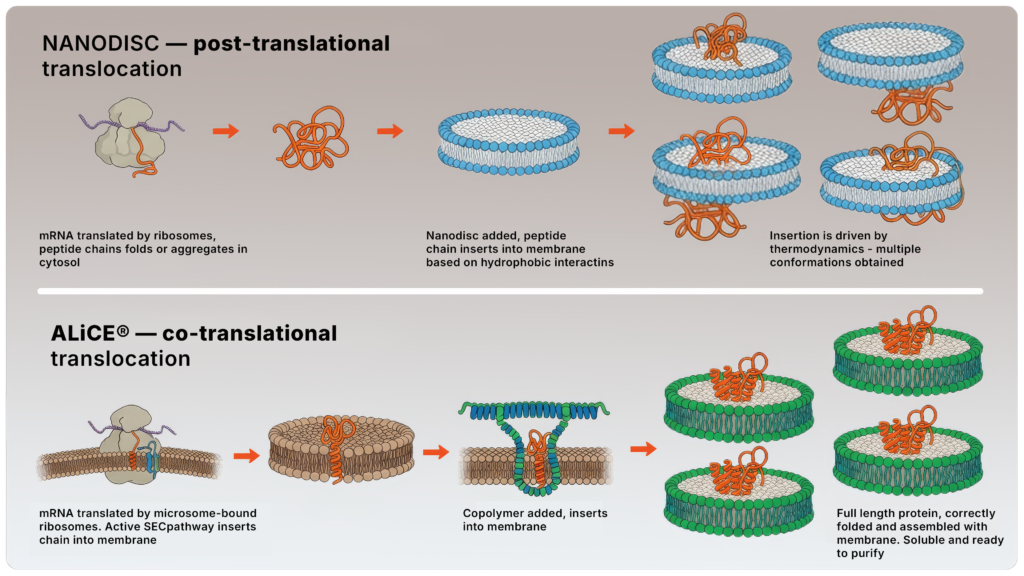
WHY NANODISCS ARE NOT THE SAME:
→ Nanodiscs require detergent extraction first — native lipid contacts are already lost
→ Protein must be unfolded/refolded into the disc
→ Synthetic lipid composition is an educated guess, not native
→ Random insertion orientation — no Sec61 directionality
→ Variable and often low reconstitution efficiency
Co-translational insertion in ALiCE® means the membrane protein folds into a native lipid bilayer during synthesis — exactly as it would in a living cell, without a detergent intermediate, without reconstitution, and without cytotoxic overexpression.
WHY E. COLI IS NOT THE SAME:
E. coli lacks the sterols and neutral lipids (like PC) required to stabilize human proteins, leading to frequent failures and poor yields. ALiCE® utilizes BY-2 cell-derived microsomes that provide a eukaryotic environment with proper membrane thickness and lateral pressure. This lipid composition prevents the “hydrophobic mismatch” and aggregation common in bacteria, allowing multi-pass proteins to fold in a native-like bilayer. Consequently, ALiCE® effectively bridges the gap between cell-free speed and the high-fidelity folding environment of a living mammalian cell.
Benefit 4 — Detergent-Free Isolation with Styrene-Maleic Acid Copolymers
Having expressed the target membrane protein co-translationally into native BY-2 microsomes, the question becomes: how to isolate it without undoing the native lipid environment?
The answer is in the use of copolymers, such as DIBMA, AASTY, or, most commonly, styrene-maleic acid (SMA) copolymers and the SMALPs they produce — Styrene-Maleic Acid Lipid Particles.
HOW SMA COPOLYMERS WORK:
SMA is amphipathic: the hydrophobic styrene moieties intercalate between the phospholipid acyl chains, while the hydrophilic maleic acid groups interact with the aqueous phase. The polymer wraps around a 10–30 nm disc-shaped patch of membrane, excising it as a soluble nanoparticle stabilised by the polymer belt. The annular lipid shell is preserved within the SMALP — cholesterol, phosphoinositides, cardiolipin all enclosed. The protein is isolated in a near-native lipid environment, not a detergent micelle.
THE SMALP WORKFLOW WITH ALiCE®:
- Step 1 — CLONE: Insert target gene with signal peptide into pALiCE02. 1–2 days.
- Step 2 — EXPRESS: 48-hour batch reaction at 25°C. Membrane protein co-translationally inserted into native BY-2 microsomes.
- Step 3 — HARVEST: Centrifuge at 16,000×g for 20 minutes. Microsomes pellet with inserted membrane protein.
- Step 4 — SMALP EXTRACTION: Resuspend in 1-2.5% SMA copolymer solution. Incubate 1–2 hours. SMALPs form spontaneously.
- Step 5 — PURIFY: Clarify by centrifugation. Purify SMALPs via affinity tag (Strep-II, His10, HaloTag).
- Step 6 — CHARACTERISE: Cryo-EM | Solid-state NMR | Native MS | SPR | Functional assays
Total time from plasmid to SMALP-isolated membrane protein: under one week.
Compare: CHO stable cell line development = 4–8 weeks minimum.
SMALP COMPATIBILITY:
- Cryo-EM: native lipid disc, no detergent micelle background, near-atomic resolution achievable
- Solid-state NMR: preserved lipid-protein interface, improved spectral line widths vs detergent
- Native mass spectrometry: tightly bound lipid adducts detectable, stoichiometry confirmed
- Surface plasmon resonance: allosteric binding sites preserved in native lipid context
Case Study — GPCRs and the CB2 Cannabinoid Receptor
GPCRs are the defining test case for any membrane protein expression platform. Their seven-helix topology is among the most complex TM architectures. Their activity is acutely sensitive to the lipid environment. Their overexpression is cytotoxic at the levels needed for structural work. And they are the most important drug target class in pharmacology.
Prior to the ALiCE® result, no cell-free protein synthesis system had produced a functional GPCR.
CB2 — THE FIRST FUNCTIONAL GPCR IN CELL-FREE SYNTHESIS:
- Target: Human cannabinoid receptor type 2 (CB2), class A rhodopsin-family GPCR, 44 kDa, 7 TM helices
- Expression: Full-length, MBP-Strep-II-His fusion, from pALiCE01 and pALiCE02 vectors
- Yield: 150–200 µg/mL — without optimisation, without exogenous lipids or nanodiscs
- Confirmation: Western blot with anti-CB2 antibody at expected molecular weight
- Functional validation: ³⁵S-γ-GTP G protein activation assay with CP-55,940 (synthetic cannabinoid agonist)
- Result: Dose-dependent G protein coupling confirmed directly in lysate matrix
- Benchmark: Comparable activity to CB2 purified from E. coli fermentation
- Reference: Das Gupta et al. (2022), bioRxiv, doi:10.1101/2022.11.10.515920
Significance: A functional GPCR in cell-free means GPCR structural biology (cryo-EM, NMR) and drug screening can now be conducted on cell-free-expressed protein, without months of stable cell line development and detergent-based purification. With ~34% of FDA drugs acting at GPCR targets, this is a transformative capability.
Target Spotlight — HER2 and PD-L1
HER2 (ErbB2):
Receptor tyrosine kinase, single-pass type I transmembrane protein. Overexpressed in ~25–30% of breast cancers. Target of trastuzumab (Herceptin®), pertuzumab (Perjeta®), and T-DM1 (Kadcyla®). Full-length HER2 including the transmembrane domain is required to study dimerisation, membrane-proximal signalling, and antibody binding in membrane context. ALiCE® pALiCE02 expression produces full-length HER2 in native membrane context for antibody/bispecific screening, ADC development, cryo-EM of HER2 dimers, and biosensor development. Contact LenioBio for current data availability.
PD-L1 (CD274):
Type I transmembrane protein, 290 aa, single transmembrane helix. Key immune checkpoint ligand — binds PD-1 on T cells to suppress immune activation. Target of atezolizumab, durvalumab, avelumab. PD-L1 clustering, cis-interactions with CD80, palmitoylation-dependent trafficking, and glycosylation-dependent stability are all membrane-context-dependent. Full-length membrane-embedded PD-L1 required for PD-1 binding studies in native context, small molecule screening targeting PD-L1 clustering, and antibody therapies targeting membrane-proximal epitopes. Contact LenioBio for current data availability.
Platform Comparison
| Feature | ALiCE® | E. coli CFPS | Wheat Germ CFPS | CHO cells | HEK293 cells |
| Co-translational membrane insertion | ✓ | ✗ | ✗ | ✓ | ✓ |
| Native microsomes (no supplementation) | ✓ | ✗ | ✗ | ✓ | ✓ |
| N-glycosylation | ✓ | ✗ | ~ | ✓ | ✓ |
| Full-length multi-pass TM proteins | ✓ | ~ | ~ | ✓ | ✓ |
| No cytotoxicity risk | ✓ | ✓ | ✓ | ✗ | ✗ |
| Detergent-free SMALP isolation | ✓ | x | x | (✗)1 | (✗)1 |
| Batch mode scalability | ✓ | ✓ | ~ | ✗ | ✗ |
| Expression timeline | 24-48 h | 4–10 h | 12–24 h | 1–2 weeks | 1–2 weeks |
| Membrane protein yield | 150–200 µg/mL | 1–50 µg/mL | <10 µg/mL | Variable | Variable |
[1] To isolate membrane proteins from living cells, you must first lyse the cells. Most lysis buffers use detergents (like Triton X-100) or harsh mechanical homogenization to break the plasma membrane. By the time you apply the SMA polymer, the protein has already been exposed to the stresses of lysis and potential detergent contamination.
Frequently Asked Questions
Q1: Does ALiCE® require exogenous lipids or nanodiscs for membrane protein expression?
A: No. ALiCE® lysate contains endogenous BY-2 ER-derived microsomes that provide the native lipid bilayer. Membrane proteins insert co-translationally without any supplementation. CB2 was produced at 150–200 µg/mL without any additions.
Q2: Can ALiCE® produce multi-pass transmembrane proteins like GPCRs?
A: Yes. CB2, a 7-transmembrane GPCR, was produced at 150–200 µg/mL with confirmed G protein activity — the first functional GPCR produced in any CFPS system (Das Gupta et al., 2022).
Q3: Is copolymer (SMALP) isolation compatible with downstream structural biology?
A: Yes. SMALPs are directly compatible with cryo-EM, solid-state NMR, native mass spectrometry, and SPR, preserving the native lipid environment throughout.
Q4: How does ALiCE® handle proteins that are toxic to conventional cell-based systems?
A: ALiCE® is an acellular system — there are no living cells to kill. Membrane proteins that cause cytotoxicity in E. coli, CHO, or HEK293 cells are expressed without constraint.
Q5: What scale can ALiCE® membrane protein reactions be run at?
A: From 50 µL in microtiter plates for screening to 1,000 mL in a rocking bioreactor, with linear yield across a 20,000× scale factor.
Q6: Why is co-translational insertion important compared to nanodisc reconstitution?
A: Co-translational insertion via Sec61 ensures correct TM helix orientation, native folding geometry, and simultaneous N-glycosylation — with the native lipid bilayer present throughout. Post-translational nanodisc reconstitution begins with a detergent intermediate, loses all native lipid contacts, and inserts protein randomly.
Q7: What is the total time from gene to SMALP-isolated membrane protein?
A: Under one week: 1–2 days for cloning, 48 hours expression, 1–2 hours SMALP extraction, 1 day purification.
REFERENCES:
[1] Das Gupta M et al. ALiCE®: A versatile, high yielding and scalable eukaryotic CFPS system. bioRxiv. 2022. https://doi.org/10.1101/2022.11.10.515920
[2] Hauser AS et al. Trends in GPCR drug discovery. Nat Rev Drug Discov. 2017;16:829–842.
[3] Gregorio NE et al. A User’s Guide to Cell-Free Protein Synthesis. Methods Protoc. 2019;2:24.
[4] Sachse R et al. Membrane protein synthesis in cell-free systems. FEBS Lett. 2014;588:2774–2781.
[5] Buntru M et al. Plant-Derived Cell-Free Biofactories. Front Plant Sci. 2022;12:794999.
[6] Dörr JM et al. The styrene-maleic acid copolymer. Eur Biophys J. 2016;45:3–21.
Contact: www.leniobio.com | info@leniobio.com | LenioBio GmbH, Technology Centre, 52074 Aachen, Germany
Summary:
This article elucidates the advantages of utilizing ALiCE® lysate for membrane protein production, addressing the persistent challenges in drug discovery. It highlights ALiCE®’s unique ability to express full-length membrane proteins with native co-translational insertion, high yield without cytotoxicity, and detergent-free SMALP isolation. By preserving the native lipid environment and avoiding common pitfalls of cell-based systems, ALiCE® emerges as a new standard for membrane protein research and drug discovery.
About LenioBio
LenioBio is a life-science biotechnology firm dedicated advancing transformative technology for the discovery, development, and large-scale production of proteins, liberating the process from conventional limitations of cells. Pioneered by LenioBio, ALiCE® is an innovative eukaryotic protein expression platform that empowers scientists globally to accelerate the discovery and development of life-saving medicines and vaccines.
Please visit our website at www.leniobio.com and follow us on LinkedIn.